
Five Changes to Make Before Buying More Decor
- Remove what belongs elsewhere. Move spare packaging, duplicate bottles and cleaning supplies out of the display area. Keep daily-use products reachable, rather than hiding everything for a photograph.
- Separate drying from storage. A basket can hold clean, dry towels; it is not a place to pile damp ones. Keep a usable rail or hook near where you need the towel.
- Compare finishes without replacing working hardware. Repeat an existing finish or try a contrasting accessory. Matching every metal and choosing quiet ceramic are styling options, not quality requirements.
- Try one color relationship. Repeat a tile or curtain detail, or compare a deliberate contrast. Check a sample beside the fixed surfaces before buying a whole set.
- Leave a usable landing spot. Make room for a toothbrush, glasses or a toiletry bag. A styled tray that fills the entire counter makes a small bathroom harder to use.
What to Borrow From This Layout
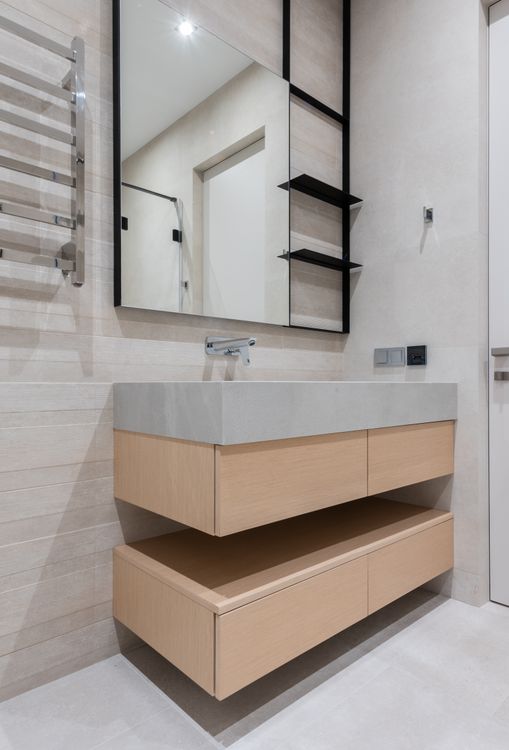
The drawers provide concealed storage while the narrow shelves leave a small area for accessible items. The open drawer also makes operation visible: a storage front has a different footprint when in use. No clearance can be measured from this photograph.
The useful principle is the split between concealed storage and a little open space. You can apply it with an existing cupboard and a small organizer; copying the fitted vanity is not necessary.
A photo cannot establish whether a cabinet finish will suit your bathroom. Check the actual product specification, particularly exposed edges and where water can collect.
Place Decor by Water Exposure, Not Just Empty Space
These are decorating zones, not electrical safety zones or building-code classifications. Observe where splashes and condensation occur in your own room.
| Area | Useful additions | What to check |
|---|---|---|
| Basin splash area | A washable soap dispenser or tray with space around it | Can you wipe underneath it? Does the finish tolerate water and the cleaner you use? |
| Beside the bath or shower | Only storage and accessories specified for that exposure | Do not assume a decorative wooden shelf or adhesive hook is suitable for repeated wetting. |
| Wall away from splashes | A mirror, suitable shelf or replaceable decorative object | Steam still reaches this wall. Check fixings, ventilation and product care requirements. |
| Toilet-only powder room | A small picture or a more decorative accessory | Usually less shower steam, but still assess basin splashes, damp and ventilation. |
If surfaces stay damp, address the cause first. The EPA moisture guide recommends using the bathroom fan or opening a window when showering. Decorative baskets and plants do not replace ventilation.
For an adhesive accessory, check the exact product and location rather than assuming every hook tolerates a shower room. Command's FAQ distinguishes its bathroom products from regular indoor strips and asks users to check shower compatibility on the package. That is not an approval for a different brand's tape or every wet surface.
Measure the Complete Item With Doors and Drawers Open
Record width, depth, height, projecting parts, open movement and how the object will be supported. Include existing doors, pipes, switches and access to equipment. A narrow shelf or organizer can still obstruct a basin, a towel or a route. Check the actual installation and location instructions before placing it.
For a hypothetical example, a 52cm-wide opening and a 48cm-wide organizer leave 52 - 48 = 4cm in width, or 2cm per side when centered. That is not a recommended clearance or proof of fit. It says nothing about depth, the opened cabinet door, plumbing, a user's reach or the support required. Use actual product dimensions, not those invented figures.
Try a drawing and the normal activity before ordering. Include cleaning around or beneath the item and how you remove it for care. An existing cabinet can remain useful; a wall shelf or extra tray is not compulsory. Seek suitable help for an uncertain fixing or installed change instead of treating this decorating plan as a drilling, electrical or plumbing procedure.
Small Bathroom Decor: Three Different Starting Points
A rental with almost no counter space
Use the existing cabinet more efficiently before adding wall storage. Measure the space inside the door and around pipes. Choose a freestanding organizer that fits without blocking the basin, and ask permission before drilling or applying adhesives.
A shared shower bathroom
Prioritize drying space, separate storage for each person and a washable surface under frequently wet toiletries. Put decoration on the least exposed wall, not on a bath edge people need to use.
A small guest powder room
Begin with a usable hand towel, basin and any storage needed. A mirror or picture can stay if suitable for the location. A patterned wall may be your starting point; compare one arrangement without requiring a sparse counter or a matching set.
Before ordering a shelf, record its width, depth, fixing method and door clearance. Check that someone can use the toilet, open the cabinet and reach a towel without bumping it. A narrow shelf can still be too deep for the position.
Build a Palette Around the Tiles You Are Keeping
Look at a towel sample next to the tile in daylight and with the bathroom lights on. Use these combinations as starting points, not rules about what your bathroom must look like.
- Cool white or gray tile: compare white towels with blue, green or a brighter contrast. Look at an actual cream sample if you are considering it; its appearance beside the tile is a preference to check, not a mistake.
- Warm stone or beige tile: compare off-white and green with a stronger color or repeated tile detail. A warmer-looking cabinet is optional, and its appearance does not establish wet-area suitability.
- Dark or patterned tile: try a repeated light tone, a darker textile or a contrast. Compare how it looks with the surfaces you keep, without requiring the tile to be the room's focal point.
A coordinated mix of towels is fine. Matching every towel is a styling preference, not a requirement for a usable or attractive room. If changing paint, use the sample and product-selection guide; a bathroom label alone does not specify preparation or application for your surface.
Bathroom Wall Art: A Frame Is Not a Waterproofing System
Do not put valuable originals, irreplaceable photographs or sentimental paper art in a humid shower room. The Canadian Conservation Institute explains that paper reacts to high humidity and that protective framing only buffers increased humidity for a limited time.
For a decorative print you can replace, choose the driest available position and discuss the frame, backing and conditions with the seller or framer. Glass on the front does not establish that the entire frame is sealed against moisture. A decorative tile or another object explicitly rated by its maker for the location may be a better choice.
We would not transfer our living-room wooden map recommendation to a bathroom. Enjoy The Wood's care guidance says to avoid damp areas. Our living-room installation is not a moisture test.
Wood, Baskets and Plants: Check the Conditions
A wood species name is not enough to judge an accessory. Finish, joints, exposed edges, construction and care instructions all matter. Do not treat bamboo, teak, sealed stone or an MDF cabinet as universally suitable or unsuitable without checking the finished product and its intended location.
Use baskets for items that stay dry and can be removed for cleaning. A wooden dish sold for serving food is not automatically a soap dish. If an accessory needs drying after every use, decide whether you actually want that maintenance.
A plant is optional. Match it to the available light, not just bathroom humidity; a windowless room is not solved by choosing a plant labeled low-light. Keep watering runoff off cabinets and walls. See our plant placement guide for other rooms where you might put it instead.
A Bathroom Decor Checklist Before Checkout
- Have I measured the usable surface, including door and drawer clearance?
- Will the object be splashed, repeatedly steamed or left standing in water?
- Does its maker specify that use and the required care?
- Can I clean around it and dry towels properly?
- Do I need permission for the fixing method?
- Could rearranging what I already own solve the problem?
For a purchase, compare the complete item, support, preparation, installation if needed, delivery, tax and relevant return restrictions. Check the actual destination and total for US or international orders. There is no tested bathroom product collection or assumed affiliate discount in this guide.
For a decorative wall outside the wet areas, compare accent wall treatments and mounting tradeoffs. If the bathroom works but feels crowded, start with the storage changes above rather than adding another ornament.