
Write a Brief Around What Happens in Your Kitchen
List the finishes you are keeping and the activities that need space: chopping, making coffee, unloading dishes, eating or working at a table. Note what repeatedly gets moved out of the way. That tells you more about the next useful change than an empty corner in a styled photograph.
Photograph the room from its entrances and measure any proposed display area. Include doors, drawers, window access, switches and the complete size of things already there. In a rental, check permission and the fixing or finish instructions before changing handles, painting or mounting anything. A removable label is not evidence that a product suits heat, moisture or the existing surface.
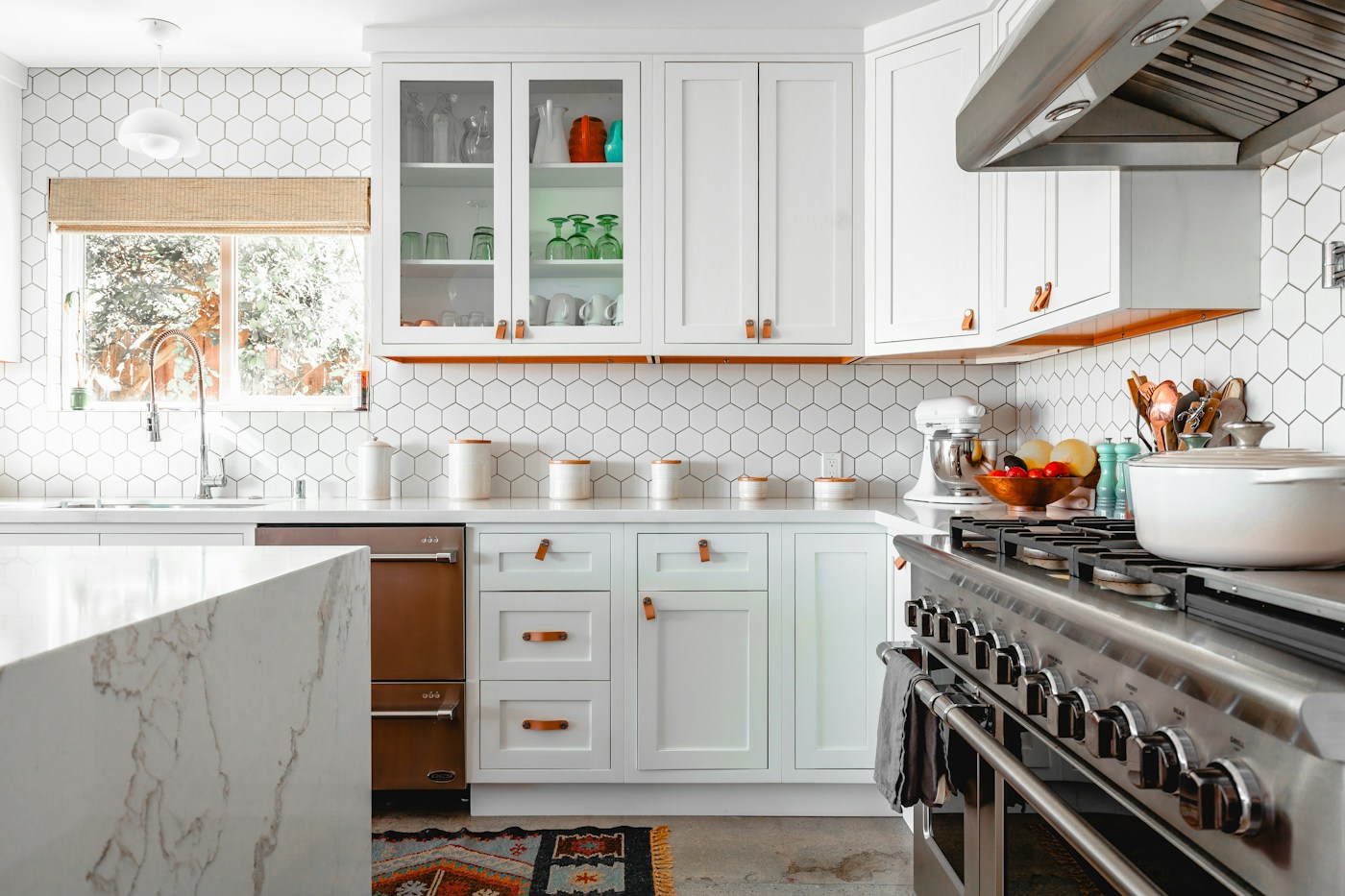
The photo gives useful visual references: repeated cabinet lines, a patterned tile surface and color inside glass-front storage. It cannot tell you the exact counter material, the fixture clearances, how the cabinets are fixed or how the room works during cooking. Take the visual idea and verify your own arrangement.
For a color comparison, notice the small orange and green details behind the glass and the darker outlines around the pale hexagonal tiles. Those are two different ways to introduce contrast without replacing the white cabinet fronts. A proposed navy or sage sample could be compared with the same retained fronts; the photo is not an edited preview of either scheme.
White Kitchen Ideas: Compare the Details You Keep
White cabinets do not require warm oak, aged brass or a single accent color to be usable or personal. Start with their actual finish and the surfaces staying beside them. These are optional comparisons, not a promise that a palette is universally warm, timeless or popular.
- Retain the white fronts and compare their neighbors
- Put a wall or textile sample beside the actual cabinet and worktop. Warm, cool and brighter whites are alternatives to compare, not a ranking of good and clinical kitchens. Check the combination in daylight and with the lighting you normally use.
- Try wood or a contrasting painted detail
- A wood finish, navy island sample, green textile or existing dark floor can provide contrast. You do not need a solid-oak worktop or a single accent-color limit. Keep the usable surface in the comparison instead of replacing it for warmth.
- Keep the metal that works
- Try an actual brass, chrome, nickel or black sample against the cabinet if you are considering hardware. In the photograph below, metal-looking fittings coexist with pale fronts and colored details; the combination does not require a matching brass tap, pendant and handle set.
- Choose where pattern belongs
- Compare a geometric tile sample, a patterned mat or a framed image separately. Plain doors and plain walls can stay plain; a Shaker profile is optional. Look at the full repeat and cleaning needs rather than assuming veined stone or ornate cabinetry is necessary.
Sage Green Kitchen Ideas: Try the Actual Sample
Use sage as a color to compare rather than a guarantee of calm or a requirement for Shaker doors and brass. Keep the fixed surfaces visible in the test. A botanical subject is one option for the wall, not proof that the rest of the room must use natural materials.
- Compare the actual green, not the color name
- Place two green samples beside the existing floor, tile and cabinet edge. Sage can describe different gray-green appearances; do not assume a blue-leaning sample will always look dull or a yellow-leaning one will always look welcoming. Check your own lights.
- Try one section, a pair of colors or the current room
- Compare a green island, green lower fronts with retained uppers, or a smaller green object. There is no required 60/40 white-to-green split. Keep the cabinets you use; color sampling does not require a fitted-kitchen replacement.
- Compare wood, dark and painted surfaces
- Try the actual existing worktop with the green sample before considering oak, a lighter stone-looking surface or a darker alternative. Dark walnut, black, pale wood and painted finishes are not disqualified. Confirm the actual material, support and care independently of its color.
- Choose a botanical detail only if you want one
- An herb illustration, personal garden photograph, abstract image or plain wall can each accompany green. Try the full frame or sample next to the cabinet. A living plant needs its own conditions; a botanical image does not create a plant-care obligation or prove a good color match.
12 Kitchen Projects Shared by All Three Schemes
Choose the project that solves your brief. Sampling a textile or moving a picture is different from installing cabinets, a surface, plumbing or lighting. Keep installed work as a separately specified and costed decision.
1. Compare a cabinet sample with fixed finishes
Keep the floor, worktop and tile you intend to retain in view. Move the same physical sample between relevant positions and compare normal daytime and evening light. A digital swatch is a shortlist tool, not the final color result. Test the actual coating or finish on the specified surface according to its instructions and any rental permission.
2. Decide where a different color would go
Compare one front, island, lower run or wall on a sketch before ordering. Include drawers and doors open and the view from an adjoining room. Several accents or one continuous color are alternatives. A percentage of navy, sage or white does not establish sufficient task light, working access or future resale appeal.
3. Keep a useful door profile
Flat fronts, recessed panels, beadboard-looking doors and existing handles can all remain. Compare how the outline casts shadows and how the exact front should be cleaned. A profile name is not proof of age or a guarantee that the kitchen will look fashionable in twenty years. Check compatibility and complete fitting cost before changing fronts.
4. Assess the worktop as a surface, not a color label
Identify the selected product and finish before comparing weight, support, water and heat exposure, preparation needs and maintenance. Timber, laminate, engineered quartz, solid surface and named natural stones need their own instructions. A thick-looking edge does not prove solid construction. Do not oil, seal, cut or install an unknown surface from a styling recipe.
5. Choose a backsplash for its actual location
Compare a plain or patterned sample beside the worktop and proposed front. Include joints, grout, substrate, cleaning and the appliance manufacturer's requirements. A white metro tile, book-matched slab or marble-looking panel is not automatically suitable behind every cooker. Matching its appearance to the counter does not settle installed suitability.
6. Keep handles and taps useful
Compare the existing hole spacing, grip, door opening and cleaning access before replacing a handle. There is no universal handle-center measurement or compulsory aged-brass finish. A tap is also a plumbing and compatibility decision, not merely a color accent. Include the complete installed cost and appropriate qualified help rather than replacing it solely to match a pendant.
7. Compare open, closed and glass-front storage
List the items to store, then check loaded support, shelf depth, reach and fixing for the actual arrangement. Existing cupboards can stay instead of being removed for oak shelves. A shelf thickness, black bracket or concealed pin in a photograph is not a load rating. Leave access to take objects out and clean around them.
8. Check light where the work happens
Try preparation, washing up and reading at the table under the existing lights. Note shadows, glare, controls and the view across a proposed pendant. Fixture size and mounting height depend on the actual item, room, task and instructions; no single island diameter or hanging height is supplied here. Do not alter cord finishes or coverings for color coherence.
9. Compare the floor or mat with movement
Try the normal path between storage, sink, cooker and seating. Check a mat's edges, stability and cleaning needs, and the specified suitability of any replacement flooring. A gray, dark or manufactured surface can remain useful. Herringbone wood or warm stone is not a necessary counterpart to a white, navy or green cabinet.
10. Try an island or stool with people using it
Keep any useful island or table and test sitting, standing, serving and opening nearby storage. A different-colored island is one possible visual change, not a reason to add another obstacle. Include the occupied stool and routes around it; its room in a catalogue photograph does not establish room in yours.
11. Choose plants and everyday containers deliberately
A herb pot, plain jar, colored glass or no display are alternatives. Consider the plant's identified needs or the container's actual intended use, condition and care. Matching handmade-looking pots are not a food-use or household-safety certificate. Keep watering, reaching and everyday food preparation separate from decorating a shelf.
12. Give art a suitable wall and a complete outline
Try a botanical illustration, abstract, family photograph or place-related image beside the actual finish samples. Include the complete frame or multi-part layout and its fixing, not just the print size. Keep it out of exposed working areas. A large wooden map is not a necessary ingredient of a white kitchen; the wall-art section distinguishes our owner evidence from merchant specifications.
For example, Caesarstone's care guidance for its fusion, mineral and quartz surfaces includes routine cleaning, protection from hot cookware and differences between finishes. Low maintenance is not no maintenance. Use the exact manufacturer's instructions for your selected product; this example does not certify every quartz surface, natural stone or material sold under a similar color name.
Give Display Objects a Place Outside the Working Area
The U.S. Fire Administration's cooking guidance says to keep things that can burn, including towels, packaging and wooden utensils, away from the stovetop. A wooden board leaned against the splashback, paper print or trailing decoration is not appropriate everywhere merely because it looks good in a photo. Follow appliance instructions and required clearances; do not derive a universal distance from this article.
- Cooking and preparation
- Protect the usable work area and access to controls. Keep decorative objects out of the way of hot equipment, cleaning and food preparation. A tray is useful only if its location and contents work with those tasks.
- Everyday storage
- Put frequently used items where the household can reach them. Compare shelf depth, load and fixing instructions before adding display storage. Closed, open and glass-front cabinets can all work; no fixed percentage of empty shelf space is required.
- Dining or another separate wall
- This may provide a better place for a photograph, picture group or personal object, but still inspect heat, splashes, sunlight, access and mounting. Do not assume an area is suitable just because it is not directly above the stove.
For a small shelf, start with what will be stored rather than adding a statement object to every level. Grouping existing cups or bowls by a repeated color is an optional visual choice. Leave access for removing and cleaning them. A display does not become better because you replace functional containers with a particular material.
Distinguish display ceramics from items for storing or serving food. The FDA's pottery guidance flags concerns about some antique, damaged or uncertain-source ware. A handmade appearance or a glaze is not proof of food-use suitability. Check the actual item rather than treating an old decorative vessel as a food container; this is not a home testing or repair procedure.
Check Visibility Before Buying a Feature Light
Try the existing light at the preparation surface, sink, storage and table. Note glare, shadows from your own position and whether switches are convenient. Keep useful general light; a pendant or strip light is not automatically a suitable replacement. Do not turn worktop decoration into a reason to reduce the light needed for a task.
Compare the selected fixture's intended location, dimensions, fitting, controls and installation instructions. A kitchen project may require a qualified electrical professional and country-specific checks. This is not a wiring guide, and a seller's room photo cannot establish an installation rating.
The lighting specifications guide distinguishes brightness, color appearance and compatible controls; its living-room layouts are not kitchen installation plans. There is no universal Kelvin setting here and no promise that warm bulbs make food more appetizing.
Use Small Details That Fit the Household
A picture on a separate wall, a washable seat cover or a colored container can add a personal detail without taking over the counter. Compare cleaning and the complete product instructions. Handmade appearance, natural fibers or a wood finish do not establish suitability beside heat, water or food.
A plant is optional. Check the precise species, light, care, access for watering and the needs of children or pets before choosing its location. Do not automatically put trailing plants above food preparation or hot equipment. The ASPCA plant database asks users to check the plant name and notes that its list is not exhaustive. A generic kitchen-plant list is not a household safety assessment.
For growing herbs, the RHS container-herb guide distinguishes species, seasonal conditions and container needs. It is not evidence that every kitchen windowsill suits basil, rosemary and thyme together. Check the identified plant and your conditions; a decorative houseplant is not automatically an edible herb, and UK seasonal timing is not a worldwide calendar.
For a textile, try one change against the floor or seating first. Check whether a mat stays stable in its proposed location and how it will be cleaned. Keep textiles away from cooking heat; a towel on an oven handle in a decorative image is not a placement recommendation.
Choose the Location Before the Artwork
Measure the whole frame, shelf or multi-part composition, including borders and projecting pieces. Check the wall and fixing instructions without obstructing cupboards or switches. If the only space is exposed to heat or splashes, choose another location or leave it undecorated.
The Canadian Conservation Institute's paper-art guide explains damage from light, heat and humidity. A frame does not by itself establish a waterproof or heat-rated display. Check the actual print, frame and location, especially for a valued original.
A food illustration, family photograph or place-related print could suit the household. Our Mapiful buyer guide covers custom-print formats and ordering questions. Check the exact design preview, frame option and delivered cost rather than assuming any advertised location or size is ready to hang.
For a wooden map, the Enjoy The Wood owner review documents our one XL Luminous world map on a living-room wall and a 4-5-hour installation. It is not evidence about kitchen exposure, other products or a removal test. The separate recorded discount-code check gives the tested cart and date, not a guarantee for every order. Choose a product only after checking whether the actual location suits it.
Our owned model is the 3D Luminous Colored Wooden World Map in XL. Placing the small islands took the most patience, and the supplied kit had everything we needed. That account is not a test of timber species, measured topographic accuracy or suitability beside cooking steam and grease. Finish names and a layered appearance do not establish solid oak or walnut. Check the exact selected model and location; confirm current eligibility, destination, delivery and total for US and international orders rather than assuming the same code result for every cart.
For a paper illustration or photograph, use the art and format guide and complete gallery layout. A botanical print, personal picture or no wall display can remain the choice. Neither color nor a frame supplies a heat or moisture rating.
A Four-Step Color Trial Without Replacing the Kitchen
This is a hypothetical sample comparison, not a kitchen makeover or a coating, cleaning or material-performance test we carried out.
- Record the retained surfaces: photograph the cabinet, floor, tile and worktop together. List the food-preparation, storage and sitting tasks that must remain usable.
- Compare one white, navy or sage change: try a real sample at the proposed position beside the retained fronts. Look at normal daylight and evening light without hiding the existing metal or floor from the comparison.
- Try one neighboring detail: compare a plain textile, colored glass or complete framed image separately. Borrow either the small colored detail or dark tile outline visible in the photograph, not its cooker-side object placement.
- Make the purchase brief explicit: record actual dimensions, substrate or fitting, care, support and complete delivery or installation cost. Include destination and custom-order return terms. Keeping the original arrangement is a valid outcome.
Make Changes in Three Passes
- Use what is there. Reorganize the objects that keep moving out of the way. Protect working space and keep the useful cabinets, surfaces and lights.
- Try a small visual change. Test one color, photograph, container or seating textile. Use the kitchen through ordinary meals before adding another item.
- Consider installed changes separately. Shelves, paint, fixtures, tiles and hardware need exact-product checks, permissions, a complete cost and any appropriate professional work. They are not interchangeable with moving a picture.
For particular visual directions, compare the Scandinavian kitchen ideas, farmhouse kitchen projects, organic modern kitchen choices and cottagecore kitchen details. Keep your functional brief in charge of the style choices, not a required level of warmth or a material quota.
For an adjoining eating area, use the dining-room table, seating and serving plan. Include occupied chairs and the route from preparation to serving rather than applying a kitchen display layout to the dining area.
Editorial, image-license and linked-source check: November 16, 2026. No kitchen makeover, appliance/fixture installation, product performance or new checkout test is claimed.