
Plan Conversation, Reading and Storage First
Mark the seats you use, door swings, access to storage and the view of a screen if there is one. Choose one change around those needs. For historical context rather than a furniture list, start with the Parisian architecture, materials and art guide.
The Jacquemart-Andre reception-room account includes red walls, dark furniture and a mixture of older elements and later work. It is one mansion's history, not a rule for all Parisian homes. Here are four color directions to compare, including the useful finishes you already have.
- White, oak and blue
- Keep a white wall and compare a blue textile with an existing timber table or floor. Warm and cool whites are both candidates; test the actual sample beside the furniture.
- Linen tones and rose
- Use a plain sofa as the background for a rose picture mount, cushion or chair. The sofa need not be linen, loose-covered or oversized to take part in the combination.
- Red and dark wood
- Borrow a color pairing from the Jacquemart-Andre music room without recreating its furnishing scheme. A red picture or single textile can be the experiment rather than new walls.
- Gray, green and existing metal
- Try a green or stronger blue accent beside gray upholstery, chrome or a dark frame. Keep useful finishes and judge the whole group from where you sit.
Keep the Sofa; Compare One Picture or Textile
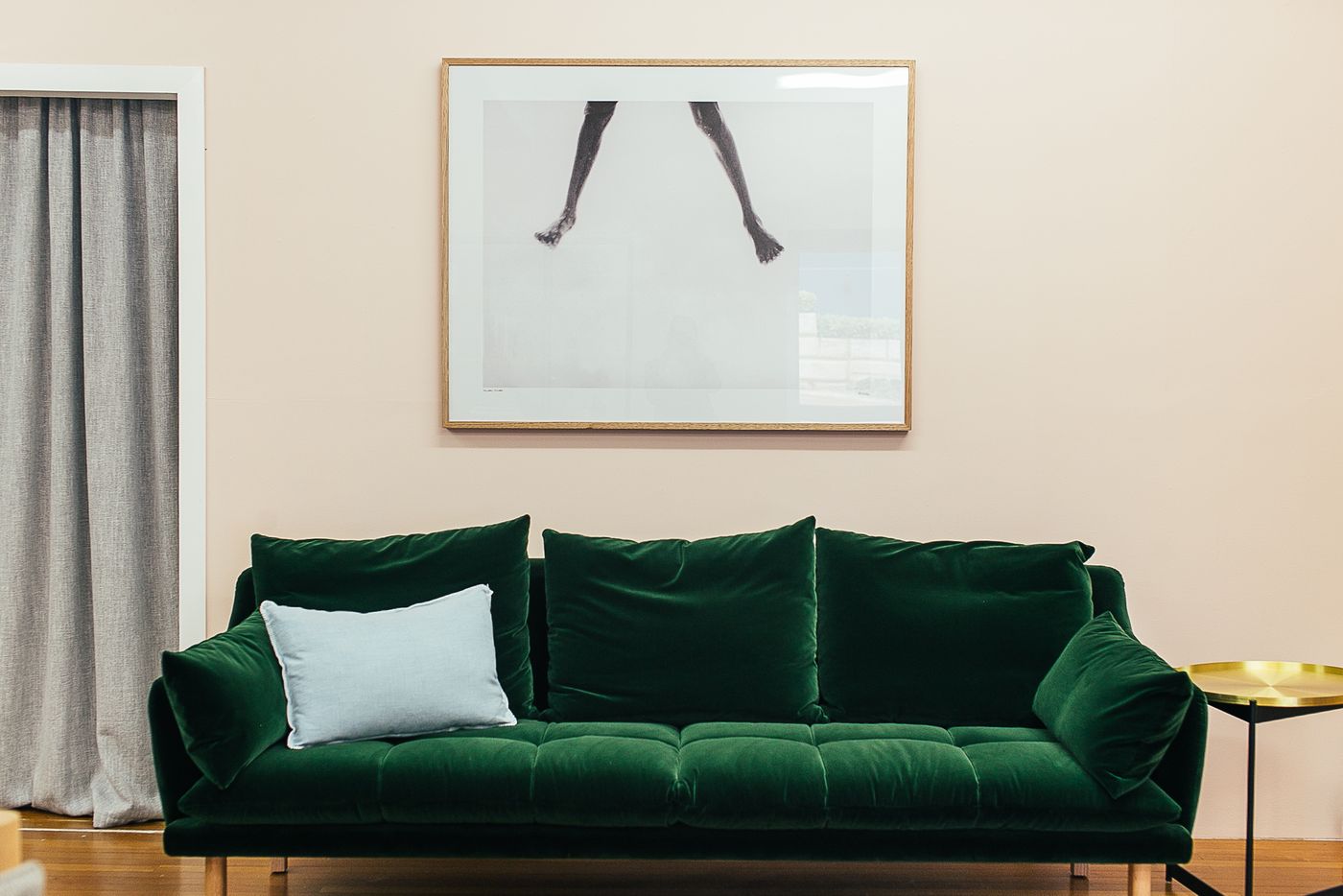
The pictured green sofa, gray curtain and black frame can stay. Imagine trying a rose cover in place of the pale cushion, or a different image in the same frame. Compare each change separately before replacing the table or curtains. This exercise does not establish the seat's comfort, the pictured hardware's support or the fabric's care requirements.
Write three short notes: what stays, the one item being compared, and what needs checking before purchase. A sample or paper outline can answer a visual question without committing to a whole-room order.
12 Projects for a Parisian-Inspired Living Room
1. Let the existing floor set the starting point
If you have parquet, use its pattern as one reference when choosing a rug or table. Otherwise keep the floor and compare a rug with the actual seat positions, doors and walking route. A patterned rug can introduce geometry without pretending to be parquet. Flooring replacement belongs in a separate project and budget.
2. Choose a sofa for sitting before its cover
Try the seat depth, support, getting up and space around occupied seats. Linen, velvet, cotton, blends and other upholstery can work. If a slipcover appeals, check its fit and stated cleaning method; removable does not automatically mean washable. A slightly-too-large sofa is not a Parisian requirement.
3. Make a gallery from pictures you want to see
Choose a small group of images before buying frames. Compare their complete outer dimensions and positions from the sofa, not only an online close-up. Varied frames can supply contrast; a matching set or a planned grid is also valid. Leave room for a later addition rather than filling every gap now.
4. Give a personal map a specific place
A city map can mark a visit, home or another connection, but it need not depict Paris. Compare a full-size outline on a wall visible from the seat, then check labels and legibility in the selected format. It can be one piece in a group or the only picture. Choose the subject because you want it, not as proof of a style.
5. Check the mirror's view and support
Look at what a mirror would reflect from the doorway and main seat: a window, picture, screen or clutter. An ornate frame is one option; a simpler frame can stay. Use mounting or anti-tip measures suitable for the actual object and wall. A heavy mirror should not merely lean loose for an informal look.
6. Size book storage to your collection
List what you need to store and keep frequently used items within a workable reach. Follow the unit's support and fixing instructions rather than using books as furniture or building unstable floor stacks. One shelf or no books at all may suit your household. A reading life does not have to be staged as a wall-sized collection.
7. Choose curtains for the window's real task
Compare privacy, glare, daylight, care and access to the window before the decorative heading. Longer panels can emphasize height where they fit, but blinds or shorter curtains may be more useful. Follow fabric and track specifications rather than applying one fullness multiplier to every product. Keep fabric clear of routes and heat sources; pooling is optional.
8. Introduce stone at a useful scale
An existing stone surround, a small tray or a table top can provide a different surface beside upholstery and timber. Check care, weight, stability and edges before buying a heavy older piece. Natural stone is not automatically more suitable than another surface. A fireplace surround is not evidence that the fireplace can be operated.
9. Compare hardware instead of replacing it all
Try a brass-colored detail beside existing chrome, black or painted fittings. A finish can repeat a frame or contrast with it; no single metal is the correct one for every room. Keep sound functional handles and leave electrical or building alterations to an appropriate project. Tarnish is not a condition certificate.
10. Leave useful space around personal objects
Give a photograph, vase, collection or decorative object a surface that still works for drinks, equipment or a hobby. Objects do not need an impressive biography, and a bought-for-pleasure ornament is not less legitimate than an inheritance. Choose the amount that works for use and cleaning.
11. Test an accent before adding an extra chair
Try a saturated cushion, picture or existing object against the larger background. If you need another seat, check it in the occupied layout with table reach and routes. A bold armchair is an option, not a required purchase; several accents can coexist when you enjoy the result.
12. Use the room, then revise one thing
Try conversation, reading, screen viewing if relevant and an evening reset. Note a real inconvenience: glare on a picture, nowhere for a drink, a crowded shelf or a lamp beyond reach. Change that before another decorative purchase. The goal is a room that supports your life, not one that appears accidentally assembled for a photograph.
Separate Artwork, Mounting and Useful Light
Choose between a single picture, a small group or a larger collection with the gallery-wall planning process. Compare living-room display positions from the occupied seat before fixing above a sofa, fireplace or cabinet. Existing structures and heat sources need their own assessment; a photograph is not a fixing specification.
For a customized map, the Mapiful buyer guide covers current preview and ordering questions. We have not tested a print. Verify the selected area, labels, complete format, framing and custom-order terms. A map of Paris is optional, not the most authentic art choice or a promise that every arrondissement and street will appear.
Retain general light and add a task lamp if needed. Check the page you read, glare on glazing, switches and cord routes. The US Fire Administration's electrical guidance covers damaged cords, rated bulbs and keeping combustibles away from lights. Its candle guidance also suggests flameless alternatives. Candles are not a substitute for useful room lighting; see living-room lighting tasks for a fuller plan.
Five Checks Before Another Purchase
- Seat and route. Try the furniture with people sitting and doors open. Remove an extra item if it makes the room harder to use.
- Display and scale. Measure the whole frame or mirror and plan its support. A well-chosen single piece can replace a dense gallery.
- Storage and care. Keep books and objects accessible, check cover-care instructions and allow space to clean around furniture.
- Light and existing finishes. Read from the actual chair and look at the art under evening lighting. Ceiling lights, chrome, gray and brighter color can remain.
- A useful stopping point. A new pillow cover or rearranged picture may be enough. No antique, weekly flowers or Paris-themed product is compulsory.
For a room with different priorities, see Parisian bed, dressing and light-control projects. For another living-room direction, compare French country ideas. Shared colors do not require identical furnishing plans.