
A Documented Textile, Not One Universal French Interior
The Musee de la Toile de Jouy's history dates Oberkampf's factory at Jouy-en-Josas to 1760. Its account includes floral, figural and geometric production for clothing and furnishings. This is a history of a particular manufacturer, not evidence that every rural French home used the same pattern or palette.
The Met's printed-textile history places the factory near Paris and discusses subjects beyond pastoral scenes. Toile is not a material category interchangeable with stone or wood, and Jouy should not be described as a Provençal village.
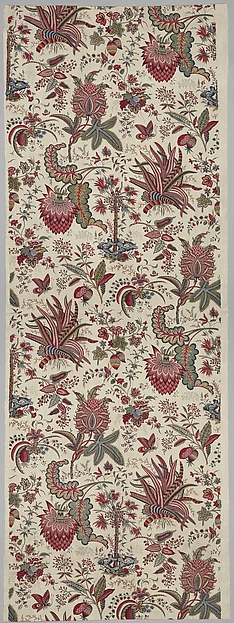
The Met connects this floral design to Indian textile models and considers clothing a likely use. Notice the repeating stems and color changes, rather than assuming every Jouy product was a monochrome pastoral furnishing. A historical image can help you describe a motif; it cannot specify a modern fabric's color match, washability or upholstery performance.
Four Palette Trials
- Cream and blue
- Compare a plain cream fabric with a blue print and the wood or metal finishes you keep. A cool white wall is not automatically a problem.
- Lavender and stone
- Try a lavender sample beside the actual floor and upholstery. A color reference does not require fragrance, a lavender plant or a promise of a calmer room.
- Sage, butter and wood
- Compare green and yellow samples with existing wood. Adjust their depth to your preference rather than making every surface look sun-faded.
- Rose, terracotta and metal
- Try a rose or clay-colored detail with a retained fitting. A bright, dark or polished finish can contrast; aged gold is not compulsory.
Keep actual samples beside the surfaces that will stay and compare them in daylight and with your usual lights. There is no required percentage, level of fading or single acceptable metal finish.
Five Material and Pattern Decisions
- Printed scenes and toile
- Look at the actual subject and complete repeat, not only the name. A pictorial scene, floral and stripe can be compared at the place they will be used. There is no required three-pattern formula or limit of one toile item.
- Painted and unpainted furniture
- Keep suitable wood, veneer, lacquered or painted pieces. Compare support, condition, touch and care before choosing a different finish. Wear does not prove age or quality, and a manufactured distressed edge is not evidence of provenance.
- Stone, tile and mineral surfaces
- Compare actual samples, surface use, weight, joints and maintenance before adding a floor or surround. A stone-look product and natural stone are different specifications, not automatically different levels of taste.
- Linen and other textiles
- Handle the sample and read construction, fiber content and cleaning instructions. A suitable synthetic, blend or crisp new fabric can remain; wrinkled aged linen is an option rather than the definition of comfort.
- Botanical imagery and personal objects
- A garden photograph, floral work, souvenir, book or ceramic can carry the reference. Choose the subject you want and the room's available space; a word sign, plain frame or matching collection does not invalidate the room.
Do not distress an unknown old coating to simulate age. EPA explains lead-dust risks in pre-1978 US home renovations and recommends lead-safe certified contractors. Assess the actual material before work; this is not a sanding or restoration tutorial.
Six French Country Living Room Projects
1. Compare the sofa with an occasional chair
Try the occupied seats, table reach and getting up before choosing a roll arm, camelback or a chair labeled bergere or fauteuil. The seller's name is not a condition or period certificate. A modern sofa can stay while you compare one patterned cushion or a separate chair that actually fits.
2. Test wall color and window fabric together
Put the paint or paper sample beside the retained floor and upholstery, then operate the window covering. Toile, linen, a plain panel or blinds are alternatives. Pooling fabric is not required; account for cleaning, movement, access and actual light control rather than buying extra length for authenticity.
3. Give painted furniture and metal details a specific job
Keep the table, bookcase or console that works before changing its finish. Existing chrome, dark iron, brass or polished hardware can remain. Check grip, moving parts, construction and any older coating before refinishing; a room need not look as though every object has been there for decades.
4. Choose a focal point without requiring an ornate fireplace
Art, a view, storage or the seating group can organize the room. Assess any fireplace, surround or mantel separately, including maintenance, support and heat clearances. Check the real reflection and fixing for a mirror; a large gilded frame is not automatically the right size or a way to enlarge the room.
5. Choose the wall subject before choosing a map
A meaningful place, family picture, floral work or print collection can be personal. Outline the full framed arrangement and compare it from the sofa. A map of France is one option, not inherently more elegant than an Eiffel Tower souvenir, and a modern city-map preview is not a historical regional map.
6. Leave table and storage space for ordinary life
Keep space for drinks, reading and necessary equipment before adding a jug, flowers, books or a tray. Check stability, care and lighting clearance. Personal collections and a tidy or matching arrangement can stay; natural materials and visible disorder are not tests of whether the home is genuinely used.
The cottagecore living-room projects and transitional seating guide offer other briefs, not a hierarchy of refinement. For wall dimensions, use living-room art planning.
Six French Country Bedroom Projects
1. Keep a bed that supports the actual routine
Try mattress compatibility, getting in and out and the occupied routes. A painted, iron, upholstered or plain frame can work beside pattern. Carving and worn paint cannot establish support, age or handcraft, and the room does not need an inherited bed.
2. Compare the pattern with bedding you already use
Try a toile, floral, embroidered or plain sample beside the duvet before adding a coverlet, bolster or throw. Read actual care and fiber information. A plain duvet or matching set is not unfinished, and more layers do not guarantee comfort or better sleep.
3. Plan the curtains for privacy and operation
Compare lining, blinds or curtains with the window and furniture in place. Check daylight, night-time privacy, cleaning and support. Full-height fabric can be considered, but a heavy pooled curtain or a faded palette is not a prerequisite.
4. Assess an armoire and any foot-of-bed seat at full size
Open doors and drawers, try dressing and mark a bench or chaise with the bed occupied. Include delivery access, assembly and support. A tall antique or reproduction is not automatically a better storage solution; consult appropriate furniture anchoring guidance for the actual piece.
5. Choose mirrors, art and their locations separately
Compare the full frame, reflection, weight and correct fixing for the actual wall. Do not default to a large work above the bed or an unsecured leaning mirror. Botanical prints are options, not a requirement to replace a personal photograph or a plain dark frame.
6. Make the bedside surface and light useful
Try switch reach, glare, cords and clearance from bedding or curtains. Keep the equipment and storage you need; a matching lamp pair is optional. Flowers, dried stems, lavender or no fragrance are personal choices, not a necessary finishing ritual or a sleep intervention.
CPSC's Anchor It! campaign addresses furniture tip-over prevention. Check the actual cabinet and appropriate fixing rather than treating decorative age or scale as an assurance. For another textile direction, compare cottagecore bedrooms and grandmillennial bedrooms; the bedroom art guide covers separate placement decisions.
Kitchen and Dining Need a Different Check
The French country kitchen guide compares fitted cabinets, sinks, tile and food-use storage. A hanging copper pan rack, natural stone worktop or farmhouse sink is optional, not proof of cooking skill or a required regional formula.
At a dining table, try the chairs occupied, open the buffet and check the serving route. Compare seat height and support for any mix of chair forms. An ornate light needs appropriate clearance, support and electrical compatibility; its aged appearance does not determine where it may hang.
Personal Wall Art Is a Separate Choice
A place print can refer to Provence, Paris or somewhere unrelated to France that matters to you. Compare the actual preview, labels, extent and full framed size instead of assuming a city-map editor can produce every region or historical design. The Mapiful buyer guide covers its formats and order checks; we have not tested its prints.
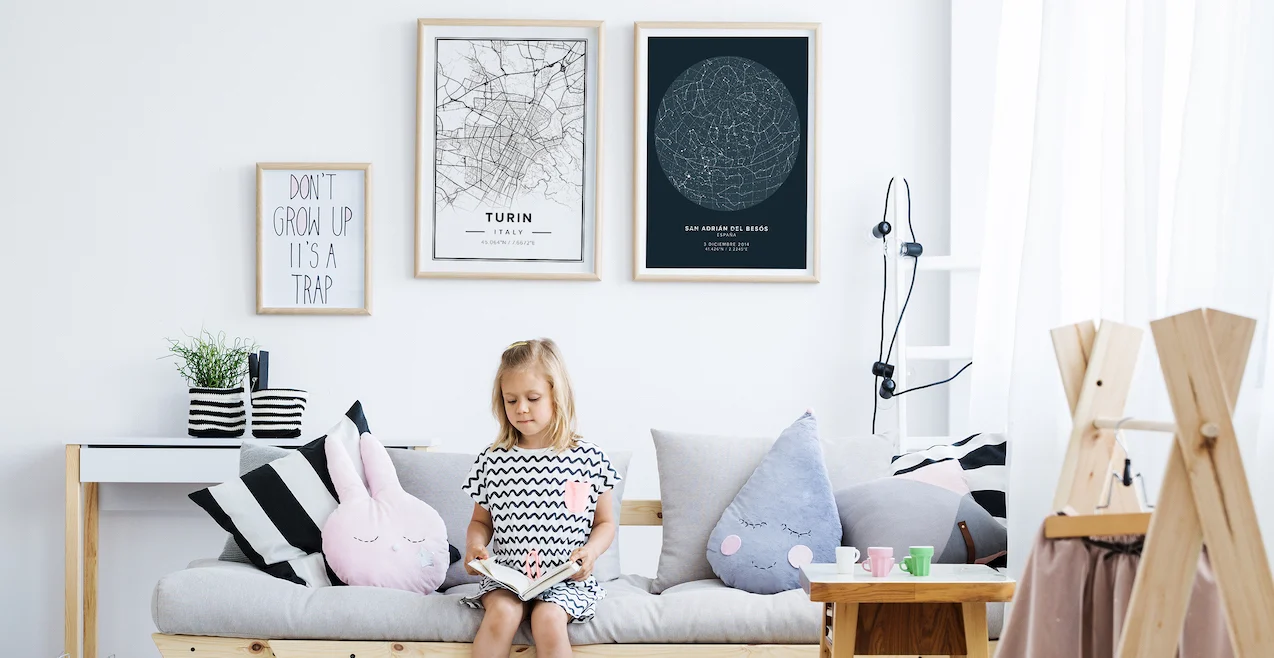
A star map, street map and pictorial textile tell different stories. Keep a photograph, botanical work or souvenir if that is the subject you want. Plan the whole framed arrangement before choosing the product or copying a position above a fireplace.
A Four-Step Pattern Trial
For a hypothetical room with a useful plain sofa or duvet, compare one printed sample before ordering curtains and upholstery. This is an exercise, not a makeover we carried out.
- Record the furniture, plain textiles and existing art you will keep.
- Get a sample that shows enough of the actual motif and repeat to understand it; a tiny crop may hide the subject.
- Place it at the intended surface and compare it from your usual seat or bed, in daylight and under normal lamps.
- Read the exact care and ordering terms, then keep, return or revise the sample before extending the pattern elsewhere.
Six Checks Before Buying
- Name the reference you actually like, not an imagined rule for every French home.
- Keep usable furniture, matching sets, necessary equipment and colors you enjoy.
- Separate an antique or reproduction claim from condition, support and known materials.
- Check actual fabric repeats, full frames, occupied routes and storage openings.
- Include delivery, fixing, qualified installation and configured-order terms in the cost.
- Keep lamp, heating and plant requirements separate from the decorative palette.
USFA heating guidance covers combustible items and professional maintenance. Its electrical guidance addresses lamp separation, bulb ratings and cords. For any plant, use its actual requirements and the RHS conditions guide. These are not installation instructions or an endorsement of a photographed layout.
For other references, compare Scandinavian design, cottagecore and grandmillennial pattern and collections. Sources and article checked November 16, 2026.